
Mississippi Storm an unwavering presence for Joe Smith, Tom Fanning
Dependable but not spectacular. A hard-nosed racer who shuns hard work. A horse who makes his connections happy but isn’t too jovial himself.
That’s what you get with 11-year-old Mississippi Storm.
And owner Joe Smith loves it all.
“I don’t think there’s a horse more deserving than him to get some recognition,” Smith said. “He’s remarkable.”
A veteran of the East Coast circuit, Mississippi Storm makes money, not headlines. He can be compared to a couple of professional Hall of Fame athletes.
Were he a baseball pitcher, he would be Don Sutton, who won 324 games but had just one 20-win season in 23 years.
“This has been as enjoyable as it gets. The fact he’s won $100,000 year after year, and you compare that to who he’s competed against … It’s simply amazing.”
– Joe Smith
There have been no spectacular wins for Mississippi Storm, but his success in high-value events and Open Trots at tracks such as MGM Yonkers Raceway, Pocono Downs at Mohegan Pennsylvania, Harrah’s Philadelphia and the Meadowlands has provided winnings of over $1.2 million.
There are no highs and lows. Just ridiculous consistency. The gelding has earned money in over 85% of his 209 career starts; hit the board in over 60% and won over 25%. In 2025, he had his eighth straight campaign earning $100,000, making him only the sixth trotter to reach six figures in that many seasons. In 2026, he will try to join Melady’s Monet and JL Cruze as the only trotters to do it nine times.
There is no sign of slowing up, as Mississippi Storm won eight of his 31 starts and hit the board 17 times for $154,430 in earnings in 2025 (as of Nov. 20), the third-most lucrative season of his career. His career high, $200,365, came in 2021.
But while he gets the job done on the track, he’s not crazy about getting the work done off it. Had he been a basketball player, he would have been Allen Iverson — famous for his rant of, “We’re talkin’ about practice! Not a game. Practice!”
That is the attitude trainer Tom Fanning must deal with.
“He’s got kind of a sour personality, and Tom says he’s got little interest in training,” Smith said. “He’ll take him out for training or jogging, and he would just as soon not bother doing that stuff. He’d just as soon do the racing part.”
Fanning merely shrugs his shoulders.
“I can train him, but he doesn’t like it,” the veteran conditioner said. “He does it, but he’s a handful. He’s just a tough horse to train. He pulls and he pulls up; he just kind of fights you. He’s just letting you know, ‘Don’t train him.’ I race him every week, and just jog him and put him in the box. If he misses time and I have to train him, he does it but he’s not happy about it.”
Actually, he’s not happy about much of anything.
“He’s a little cranky,” Fanning said. “Some days he’s good; some days he’s not good. When he’s feeling cranky, I just stay away from him. Some days you can pet him, give him treats, and he’s OK. Other days, he’s not.”
Smith chuckles at the battles horse and trainer have in the stable.
“If you give him a treat, he’ll take the treat and then take a bite out of you,” the owner said. “He’s not exactly a pleasant horse. I think Tommy’s got a number of bruises on his arms to prove it.”
But Fanning accepts the pain for the payoff.
It was jokingly suggested that Mississippi Storm is good during races due to the energy he saves by not training.
“That might be it,” Fanning responded. “But when he’s racing, (his personality) is no different than the other six days of the week. You just clean him up, put him on the truck, and race him.”
To hear him talk, Fanning low-keys his contribution to the process. Asked how Mississippi Storm has lasted so long, the trainer said, “I don’t know. Maybe it’s just good genes on his part. I just try to stay out of his way, and he responds.”
Smith knows that’s not true as he praises the job done by Fanning as well as Maria Garcia, the horse’s caretaker since Smith bought him, and his veterinarian, Dr. Steve Bokman. Smith credits the three of them with keeping the horse running smoothly throughout his career.
“He’s healthy,” Smith said. “Tom has done a remarkable job in terms of his racing schedule. He’s never over-raced him, and he makes sure he gets a race when he needs it. That’s an art form.
“It’s kind of an interesting story. There’s something about him, the durability and the personality, but it’s also the story of the people who have provided the support to keep him going so long. You would think each year he would slow down, but he still gets around Yonkers in [1]:53 and change.”
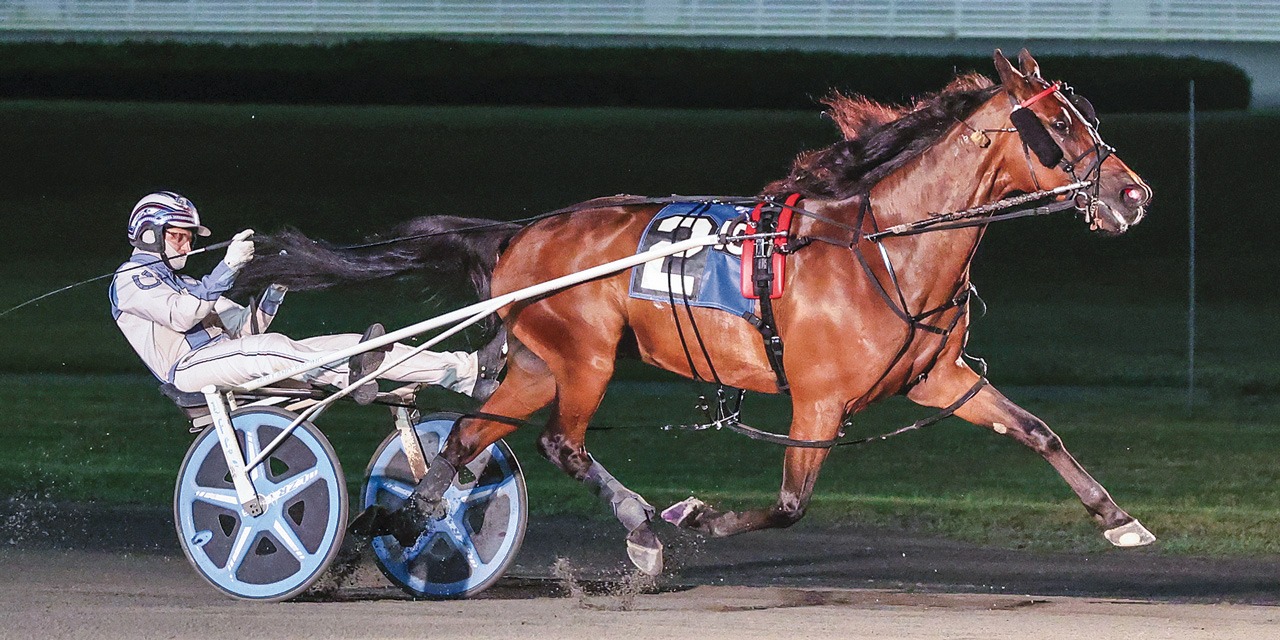
GUIDING HANDS / Brent Holland has been Mississippi Storm’s main driver during the mercurial gelding’s nine years on the track. Mike Lizzi photo.
A son of Cantab Hall out of Mississippi Beauty, Mississippi Storm was purchased by Smith in December 2017 after winning four of eight races as a 2-year-old for trainer Julie Miller and owners Andy Miller Stable Inc. and Willow Oak Ranch. At age 3, he captured divisions of the Simpson Stakes, Keystone Classic and Liberty Bell, and was he third in the Matron Stakes and the consolation of the Zweig Memorial.
Moving forward, much of Mississippi Storm’s success came in top-level trots — especially at Yonkers, where he has won the most races, 29, including nearly a dozen at the Open, Invitational and Preferred levels.
“We came up with the idea collectively we’d like to invest in proven 2-year-old trotters that had actually done something, see how they do as 3-year-olds, and maybe we can make some money,” Smith said. “The idea was longer-term and to turn them into good racetrack horses. We’re not just buying them for one year, but for what they can do over multiple years. Tom’s been able to pull that off.”
Fanning said he can get a feel after a while about what level to race a horse like Mississippi Storm:
“He’s kind of a cut below the top horses but he’s very dependable,” he said. “When the good horses were at the Meadowlands, we were at [Harrah’s Philadelphia]. When they were at Pocono, we were at the Meadowlands.
“He’s made the most money for me, like $1.2 million, so that makes him my favorite. You can’t predict it, but we’re grateful for it. Joe has been very fortunate; he’s had several horses who have done well for quite a while before tailing off.”
The duo also teamed up on Sumatra, who had six $100,000 years, and Fashion Creditor, who banked five six-figure seasons.
“He’s a great guy to work for,” Fanning said about Smith. “He’s been fantastic.”
Throughout his career, Mississippi Storm has competed against Grand Circuit winners and Dan Patch Award recipients such as Six Pack, It’s Academic, Amigo Volo, Manchego, Atlanta and Obrigado.
Smith was impressed by Mississippi Storm after he raced well in Pennsylvania stakes as a 2-year-old. And the horse has just kept on impressing.
“Roll the film forward to where he’s 10 now, and Tom’s skill level in keeping these horses going and how he schedules them and trains them, it’s really impressive,” Smith said. “He’s not large. When Tom used to drive him, he called him ‘the tough little guy.’”
Brent Holland has been Mississippi Storm’s main driver over the years, and both Smith and Fanning praise the way he handles the horse.
“I don’t say anything to Brent before the race; he knows what to do,” Fanning said. “If he’s got the outside and can make the front, he’ll try for the front. If he can’t, he takes him back. He’s a very good driver.”
Mississippi Storm has changed the way he likes to race. Previously, he liked to race on the front, but now he prefers to close in the final three-eighths of the mile. One thing that has not changed is his ability to succeed on the smaller tracks.
Fanning attributes his ability on the smaller tracks to his gait, saying, “He gets around the turn as good as down the straights, and that is a big advantage for him.”
As the horse takes aim on tying the record for $100,000 seasons recorded by a trotter, the question begs as to how much longer he can go. The man in charge is taking it as it comes.
“I’m gonna race him while he can still compete at the high level,” Fanning said. “If he starts to tail off, gets a little sore, or isn’t able to compete at the level I want him to, then we’ll stop him and give him a nice home.”
Whenever that may be, one thing is certain: Smith will always look back on the Mississippi Storm era as one of his favorites.
“From my perspective, this has been as enjoyable as it gets,” he said. “The fact he’s won $100,000 year after year, and you compare that to who he’s competed against. He was competing with the best trotters in the world at age 9 at the Grand Prix [Trotting Series] at Yonkers. It’s simply amazing.
“As soon as he had 50 wins, I got one of those pavers for the Hall of Fame so he would get his name on that walkway [leading to the Harness Racing Museum and Hall of Fame]. When you look at who’s in the Hall of Fame at Goshen, it’s a lot those stakes-winners at 2 and 3 years old; all the breeding stock. But if they had a separate Hall of Fame for racetrack horses, he sure as hell would be in it.”
This story appears in the January 2026 issue of Hoof Beats, the official magazine of the USTA. To learn more, or to become a subscriber to harness racing’s premier monthly publication, click here.