
Columbus, OH – Since its creation six years ago, the Standardbred Racing Investigative Fund has worked on behalf of the U.S. Trotting Association to investigate allegations of wrongdoing within the harness racing industry. And while uncovering misconduct is SRIF’s focus, education also plays a valuable role in supporting SRIF and the USTA’s joint goal of promoting integrity within the sport.
SRIF, a 501(c)(3) nonprofit, works in partnership with the USTA. Headed by attorney Carson Morris, SRIF’s legal counsel, and lead investigator Vicki Humphreys, a former special agent with the Federal Bureau of Investigation, SRIF investigates suspected violations of the USTA’s rules and bylaws at the behest of the USTA through an alliance agreement. All SRIF’s work on behalf the USTA is subject to independent third-party oversight.
Several investigations already completed by SRIF have resulted in USTA disciplinary action. But, as Morris wrote last year in an article for Hoof Beats magazine, “The goal is not just to catch wrongdoers but to reform the cultural norms and expectations in Standardbred racing so that misconduct does not occur in the first place.”
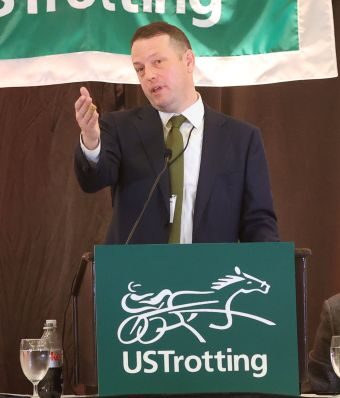
Education is a road to that destination. While the priority is to keep the harness racing industry informed on the work SRIF is doing, the USTA and SRIF have stepped into the forefront on integrity initiatives common to all equine sports. Morris this year presented on the topic of SRIF at conferences hosted by the Organization of Racing Investigators and the Association of Racing Commissioners International. He will speak at the 40th annual National Conference on Equine Law in Lexington, KY, April 29-30.
“I think it’s essential to engage with stakeholders in the industry to show our commitment and the good work that we’re doing,” Morris said. “Hopefully, we can share information with other breeds and collaborate. These are problems that everyone faces, and I think we’ve figured out an effective way to address it, and how necessary it is for us to carry out investigations the way we have been.
“Communication is almost as important as doing the work and having successful investigations. If people don’t know what you’re doing, if they don’t get the message, then that cultural change doesn’t happen. People need to know this type of misconduct isn’t going to be accepted. I think the message is getting out. I think this is a source of positive change.”
Among the misconduct SRIF has focused on is the fraudulent ownership of Standardbreds by ineligible individuals, a practice commonly known as “bearding,” and those who help enable the practice to occur.
In addition to conducting investigations, SRIF identified areas where the USTA’s rules could be updated to better reflect the association’s enforcement goals. Recommended revisions were adopted by the USTA Board of Directors in March 2025 and went into effect in May of that year.
The formation of SRIF came as the result of Hanover Shoe Farms establishing a $250,000 matching fund grant in 2020 to promote integrity in harness racing. When SRIF was formally launched, Hanover Shoe Farms President and CEO Russell Williams, who also is the president of the USTA’s Board of Directors, emphasized that great care was taken to maximize independence and confidentiality in the investigative process.
“At the end of the day, it’s about making sure every USTA member does things the right way; honest, accountable, and above reproach,” said TC Lane, the USTA’s chief operating officer and director of registry. “Some of the feedback we’ve received over the years is that the industry needs to rid itself of wrongdoers. This work represents a significant investment, and Russell and Mike (Tanner, USTA Executive Vice President/CEO) have been key advocates in moving it forward. They are not involved in the oversight or execution of (SRIF’s) day-to-day investigations or decisions. They have intentionally stepped away from those responsibilities, allowing a defined, transparent process to operate independently and ensure fairness.”
Lane is among three members of a screening committee composed of SRIF board members and USTA officials that reviews information regarding suspected misconduct, and authorizes SRIF to pursue investigations. The targeted misconduct often falls outside the jurisdiction of state racing commissions and requires the expertise and resources SRIF brings to bear.
Regarding the investigative process, members suspected of misconduct receive written notification of the allegations against them and related potential rule violations. Members may also receive requests for records and information in a SRIF investigation, which the USTA has the power to request under its rules. Compliance with these investigative measures is essential to SRIF’s ability to undertake fair and effective investigations. Accordingly, as authorized by the rules, failure to comply can result in fines or suspension from the USTA.
“We are transparent from the beginning in terms of what we are looking at,” said Humphreys, who following her work as a special agent with the FBI founded the HML Group, an investigation, consulting and advisory group catering to public and private sector clients as well as non-profits. “In the investigative process, in addition to conducting interviews, you’re reviewing records and documentation that either prove or disprove the allegations at hand. In my view, the record review is a really important part of the investigation because it either corroborates what the person is saying, or it doesn’t.
“We don’t go into any investigation with a preconceived notion that somebody has done something wrong, or not. We are simply looking at the evidence, looking at the facts, and making a determination based on that as to whether any of the USTA’s rules or bylaws have been violated.”
Morris, an attorney with the law firm of Montgomery McCracken Walker & Rhoads, is a former deputy attorney general in the Pennsylvania Office of Attorney General. His experience as both a prosecutor and defense attorney makes him sensitive to both ensuring that necessary steps are taken to carry out an effective investigation while recognizing the rights and interests of investigated members. He added, “We try to make our request as narrow as possible, just for efficiency and also out of recognition of the burden it can place on the member. Every record request letter welcomes a dialogue. It also says we will do whatever we can to help you and assist you. If you have any problems getting anything, please don’t hesitate to call us. And that’s the way it’s supposed to work.
“Basically, our authority is rooted in registration and the integrity of the registry. Everything we do has a very specific purpose based on decades of experience. We’re not just winging it. It’s also for the benefit of the members because it would be irresponsible for us or the USTA to accuse someone of something without knowing as much as possible about the facts. Fairness is really the key to the whole thing; the layers of review, the layers of opportunities to be heard. And it’s all happening confidentially until there is a public finding.”
At the completion of an investigation, SRIF presents a detailed summary of its findings to a five-member committee made up of USTA directors. That committee provides investigated individuals with all the evidence gathered in the investigation, detailed notice of the allegations against them and related rule violations, and an opportunity to appear before the committee and dispute the proposed findings. Members may have an attorney represent them at a hearing and all stages of the investigative process. Following the hearing, the committee recommends sanctions, if warranted, to the USTA board or executive committee. Members of the board or executive committee make the final determination on disciplinary action. SRIF personnel strictly act as investigators and advocates. The power over a member’s standing rests solely with the USTA.
“People are given an opportunity in multiple forums, in front of multiple groups of people, to present their side of the story until there is ultimately a final finding,” Morris said. “Not everything we do ultimately results in an allegation of misconduct. Everything is done as part of the commitment to have layers of fairness and review and transparency before there is a final finding.”
Results from completed investigations can be reported to racing commissions or other appropriate authorities.
“One of the things I’ve noticed, SRIF has done a really good job of facilitating a lot of that information between the states,” Lane said. “Something much better than the industry has ever experienced before. I have seen extreme growth in the lines of communication from an investigative and regulatory standpoint in the last few years, much more than in the last decade or so. I’d have to think that due to the industry acceptance of SRIF; I think they’re primarily responsible for that.”
Said Humphreys, “There is more work to do, but I think we’ve made great strides. I think people are taking us seriously now. I think that’s very much of a positive for the industry.”