
Racing under Hawaii’s volcanic skies
Hawaii is the last place anyone would expect to find harness racing. However, at one time, under the heated glow of a volcanic sun, the rhythmic thunder of hooves cut through the island’s quiet, with horses chasing glory on a dirt oval not far from Waikiki waves.
Horses — let alone Standardbreds — were not indigenous to the island communities. American merchant trader and navigator Richard J. Cleveland (1773-1860) was the first to bring an equine to Hawaii when he presented a horse as a gift to King Kamehameha I in 1803. Impressed by their beauty and athleticism, the king requested more horses, which led to numerous imports of various breeds over the ensuing decades.
Soon utilized as tools for cattle and farm management, the king brought Mexican vaqueros (cowboys) to Hawaii to teach the locals horsemanship and riding skills (known as Paniolo, or Hawaiian cowboy). Along with cattle ranching, roping and reining, Paniolo traditions remain strong today with a distinctive Western riding flair that can, at times, seem out of place in a tropical paradise.
Despite their practical uses, horses quickly became ensconced on the various Hawaiian islands and were seen as elements of prestige by wealthier members of those communities.
Racing — both Standardbred and Thoroughbred — began initially on the island of Maui as early as 1872, when the Hawaiian Jockey Club was founded. According to a June 9, 1886, feature in the Honolulu Star-Bulletin, the $75 Queen Liluokalani Plate Free For All was offered for both trotters and pacers, in one-mile dashes, the best of two of three heats, for horses who had never beaten 2:25. Also on the program was the $125 Waihee Cup Free For All, for trotters and pacers, one-mile dashes, the best three out of five.
The Kapiolani Park Association was formed in 1880; three years later, the one-mile Kapiolani Park Racetrack was established on the southern shores of the island of Oahu, becoming a focal point of Hawaiian high society. At the time, it was known as a retreat for the Hawaiian royals. The park initially featured a grandstand, clubhouse and stabling areas before it was demolished in 1914, when local interest in racing waned.
The first racetrack on the big island of Hawaii was located in Hilo, just a stone’s throw from the ocean. It began as a sand runway but was later moved further inland and became Hoolulu Park, officially inaugurated on June 3, 1901. Horses, both tail-sitters and the runners, were routinely shipped between the islands — and from the mainland, as well —for racing meets, with many of the top horses that competed in California making their way to Hawaii, including the famed trotter The Harvester.
That first meet at Hoolulu Park (July 4-6, 1901) was covered by the Hawaiian Gazette, which reported that “the sport was of an interesting nature, and the majority of events were well contested … the racing was of better class and productive of several exciting finishes.”
One horse that was celebrated ad nauseam at Hoolulu was Waldo J, a gray stallion who became the champion pacer of the Hawaiian islands during his reign in the sun. He raced from 1901 through 1912, becoming the islands’ most famous son along with his stablemate Cyclone, another pacer trained and driven by Jim Quinn, with both horses having been born and raised in the shade of those island volcanos. Those two, and a host of others, brought crowds of curious fans to the races at Hoolulu Park, where quarter-, half- and mile events were contested, with the Free For All offering a purse of $125 to the winning pacer or trotter.
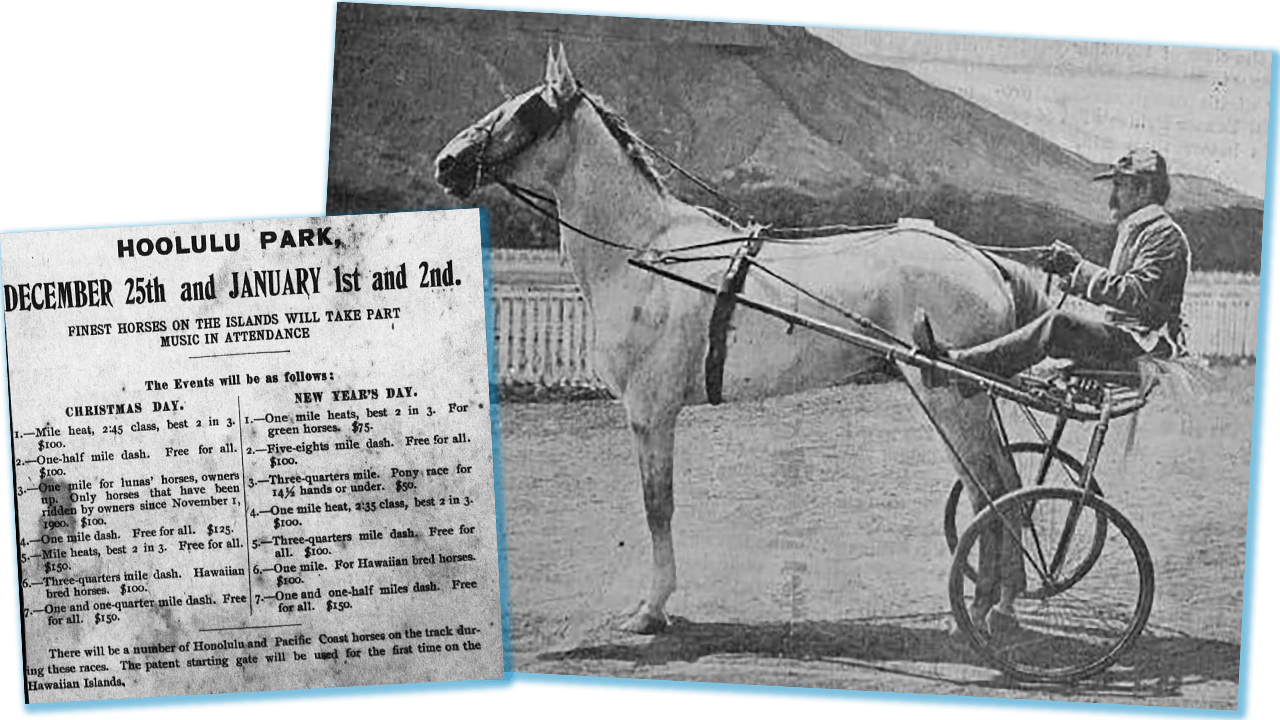
Hoolulu’s second meeting, on July 11, 1902, featured a showdown between island rivals Wayboy and Sambo, with the former besting the latter in two straight heats of 2:33 and 2:23 when they met for the first time. Wayboy was owned by Honolulu resident G.S. McKenzie, who later shipped his stable to Sacramento, Calif., with a group that included Socialist, Time Center, Del Vista, Nullah and General Cronjie, all under the training eye of conditioner Bob Burns. Sambo, who was previously raced under the name Seamplough on the mainland, was trained by Charles David “Dutch Dave” and driven by Jack Gibson, Honolulu’s premier reinsman.
Other races that year featured a half-mile dash, a six-furlong dash, a 1:18 class trot and pace, and a one-mile contest known as the Hilo Track Cup.
Waldo J later took a mark of 2:12.2 at Maui, as reported in the Feb. 14, 1908, Honolulu Star-Advertiser, which also read, “Harness horses at present on Maui include D.H. Davis’ Adbine (2:17); W. H. Field’s Faro Bank (2:17¼); D. H. Davis’ Hawaiian-bred pacer I’m For You; Dan T. Carey’s pacer Luke R; D. H. Davis’ Cyclone (2:15).” Later, at age 12, Waldo J lowered his mark to 2:08 with Quinn at the lines. Sadly, Waldo J never made it to the mainland and instead plied his wares over the volcanic dirt. It is never known what became of him.
Unfortunately, harness racing did not survive its early popularity in Hawaii. By the end of the 1920s, horse racing had been phased out of the public mindset, largely due to gambling concerns. Hoolulu Park was later made famous when Babe Ruth gave a slugging exhibition there on Oct. 29, 1933.
The only other connection between harness racing and Hawaii was driver Victor Reeves, a native of Hawaii who competed in New York but died suddenly of a heart attack when he was just 37, only moments after winning his first drive at the Monticello Raceway winter meeting in December 1980. Reeves fell from the sulky after steering Cheryl Grattan to victory and was rushed to a nearby hospital, where the cause of his death was listed as cardiac arrest.
This story appears in the May 2026 issue of Hoof Beats, the official magazine of the USTA. To learn more, or to become a subscriber to harness racing’s premier monthly publication, click here.