
Jake Kiefer Jr. relishing second stint in harness racing
It’s only fitting that Jake Kiefer Jr. retired from his full-time job on Easter Sunday, since that is the day his harness racing career was resurrected.
The short story is that the 67-year-old native of northern New Jersey grew up working at harness tracks as a youngster and decided to make a career of it. He got his “A” driving license at age 18, and from 1979 to 1987, his best driving year (1986) produced nine wins and $19,942 in purse earnings.
Not the most lucrative of careers, but enough to keep him plugging away.
By his early 30s, however, Kiefer decided it was time to make serious money to raise a family and be able to spend time with that family. Thus, he became an operating engineer in various power plants for Public Service Electric & Gas (PSE&G), New Jersey’s oldest and largest regulated electric and natural gas delivery utility.
But as most people in the Standardbred world realize, once the sport gets in the system, it never quite leaves. Thus, when Kiefer walked out of the power plant for the final time, he found himself walking back into the stables.
Resurrected!

BACK IN THE BIZ / After a 36-year hiatus from full-time involvement in the sport as a driver, Jake Kiefer Jr. has returned, this time as a trainer, plying his trade mainly at Yonkers, the Meadowlands, Monticello and Goshen Historic Track. Photo courtesy Jake Kiefer Jr.
“I got out of the (Standardbred) business to get more of a secure future,” Kiefer explained. “I’m enjoying my pension, my annuity and my social security, so I don’t have to worry about money. My son (also Jake) is a veterinarian. I wanted to put him through vet school, so he’s all set.
“I always figured I’d come back into the business when I retired. I came back, and things are going pretty good. The two horses I have racing (Foreign Xchange and Jakey Jumpup), a 3-year-old and a 5-year-old, both won, so they’re doing well and I’m having fun. That was the main thing: having fun in this business.”
Since his return, Kiefer has mainly stuck with training and has had just seven driving starts since 1990. Through his first 29 starts as a trainer in 2026, Jake had three wins, one second-place finish, five third-place finishes, and $29,660 in purses.
“That’s not bad for a guy who was out for 36 years!” he said, proudly.
Kiefer did dabble during his time with PSE&G. From 1989 to 2024, he had 15 driving starts and hit the board twice. He feels his days in the sulky are over . . . kind of.
“I’m getting kind of long in the tooth; I think the driving is behind me,” Kiefer said. “I was good as a kid. I drive a little bit now, not that much.
“But I know that not driving is gonna get to me. You do all the work for the whole week and then you put somebody up for two minutes. And if things don’t go well, you say, ‘Shoot, I could have done that.’ I know it’s gonna get to me after a while.”
The Standardbred bug got to him at an early age. Kiefer grew up 20 miles west of the Meadowlands, the son of a prison guard lieutenant who had bred a few horses on the side. Kiefer’s interest in the sport, though, came from going with his friend’s father and uncle to Yonkers, Monticello, and the now defunct Roosevelt and Brandywine raceways.
Kiefer fell in love with the business. Unfazed from having to start out in the muck and the mud, he spent his summers off from school working at Pocono Downs and the now defunct Liberty Bell Park.
“I’d live on the grounds for a couple of months and then I’d go back to school,” he said. “Some kids would go and caddie at a golf course for their summer job; I wanted to get a job at a racetrack.
“I started out at the bottom. They’d let you clean stalls. Next time I got a job, I’d put a harness on a horse; eventually I started jogging. When you knew what you were doing, then they let you do what you knew.
“In the beginning I knew nothing, like most people. Nobody is born into this business to know it all. I didn’t have a dad who was a trainer or anything like that, so I had to learn myself. My father dabbled a little bit with breeding mares, but he never put any money into it.”
He got his education from others. Kiefer worked for Hall of Famer Vernon Dancer, along with Jimmy Larente and Dick Hogan, who had the distinction of driving in the first-ever dead heat (against Eldon Harner) at the Meadowlands, in 1976, the year the track opened.
“I worked with some really good people,” he said. “Dick Hogan was a wizard, a great trotting man.”
After getting his full “A” license, Kiefer lived in Freehold, N.J., for a while and drove up and down the East Coast.
“I went on my own, went back and forth in between tracks,” he said. “I’d have a horse here, a couple horses there. I stayed in the business until I was 32.”
The young man was having the time of his life, but when he and his wife, Robin, had their son, Jake, and daughter, Jacqueline, fun money wasn’t going to be enough.
“I was 110% in the horse business,” Kiefer said. “It was a good business, but it’s not a good family business. You’re traveling a lot, the kids are in all different schools. I didn’t grow up like that, and my wife surely didn’t. We didn’t want that for our kids.
“So, I figured I’d make myself a deal. If I get a good job, I could raise a family and do the normal thing, so to speak, and then come back to this.”
Kiefer did not have a college degree, but that didn’t mean he wasn’t smart. He took an entry test at PSE&G and was hired several weeks later. His first jobs were in his home state, in Linden and Newark, but for the final 22 years, he had to cross the heavily congested George Washington and Robert F. Kennedy (previously Triborough) bridges to Queens, N.Y.
“I woke up at quarter to four every day,” he said. “It wasn’t easy, but I saw a light at the end of the tunnel and I said, ‘If I’m healthy enough, I can retire and I can go back into horses.’”
During his time at PSE&G, Jake was a power plant engineer dealing with fossil fuel and natural gas. He would perform maintenance, operate machinery, weld, work with the electric and a plethora of other things.
“You’re kind of a jack of all trades in the power plant,” he said. “Once you get experience in the power plant, you can basically go to any power plant in the country and get a job. There really are no schools to teach people how to work in a power plant. That knowledge was unbelievable; I can do a lot of things with that knowledge.”
But with that knowledge comes peril, as power plant labor has its risks. But the way Kiefer looks at it, so too does his other job.
“Working in a power plant and racing horses are both very dangerous,” he noted. “It’s the element of surprise. You don’t really have any defense for what can happen.”
Such as?
“In a power plant, you have high pressure steam that can cut you in half if a pipe breaks,” he explained. “You have electrical hazards and rotating equipment hazards. You cannot be off your guard any day. Racing horses, even though you think you have things under control, an accident can happen at any time. The bottom line is, in both professions, you can never take safety for granted.”
And yet, he jumped from one job that requires extreme caution to another as he bunny-hopped his way back into the stables right after Easter. He mainly races near home at Yonkers, the Meadowlands, Monticello and Goshen Historic Track.
Kiefer’s return debut resulted in Jakey Jumpup taking third in an overnight race at the Meadowlands. Jakey took another third at the Big M on June 19, and elation hit on the Fourth of July when Jason Bartlett drove Foreign Xchange to victory in 1:57.3 in a Landmark Stakes at Goshen.
It was a defining moment that let Kiefer know he still had it.
“When you’re out of the business full time for the length of time I was, and with all the changes in the business, and being 67 years old, you naturally have some doubts if you can do this anymore,” he said. “When Foreign Xchange won the Landmark at Goshen, I turned to my son and said, ‘I’m back!’”
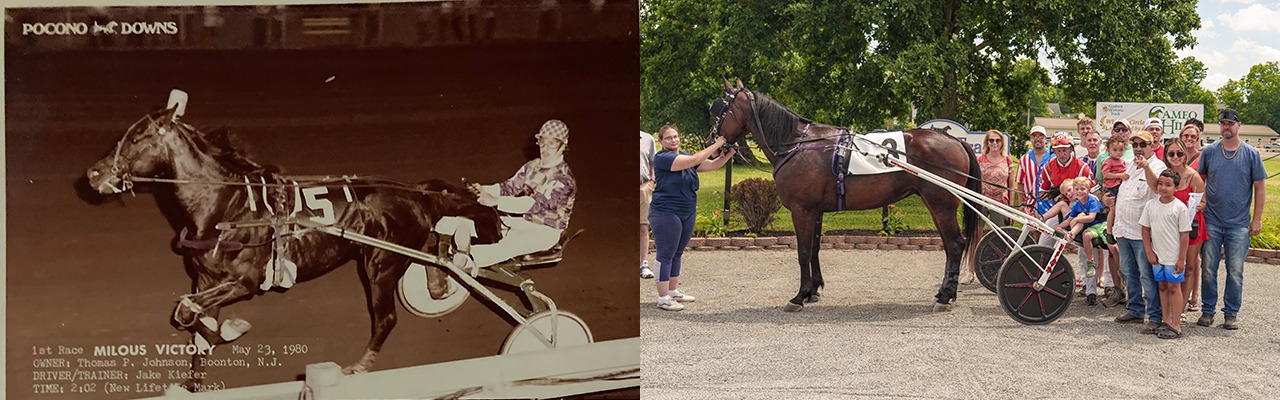
THEN AND NOW / Left: Kiefer enjoyed a modest career as an East Coast driver in the 1980s before leaving the sport to become a power plant engineer. Right: A defining moment for Kiefer (in purple, behind driver Jason Barlett) in his new career as a trainer was Foreign Xchange’s win in a Landmark Stakes at Goshen Historic Track this past July. Pocono photo courtesy Jake Kiefer Jr.; Goshen photo by Adam Ramli Photography.
The changes Kiefer spoke of were not so much how horses were dealt with, but with the fact that grooms, for the most part, no longer live in stabling areas at the tracks, and that financing is more important than ever.
“It’s a money game now,” he said. “If you don’t have the money to buy real good horses, or if you have that money but don’t have the courage to buy real good horses, then you’re behind the eight ball.”
When Kiefer first left the business, it was tough. He would scan websites to see where his friends were racing and how they were doing.
“It was burning me,” he said. “But it got to the point where I said, ‘I did the right thing, that’s what I wanted to do,’ and I never looked back.”
Doing what he did helped his family. He and Robin, a former scientist and chemist, celebrated 40 years together in October. The two are extremely proud parents.
Son Jake is an equine veterinarian and owner of Winner’s Circle Equine Veterinary Services, near Goshen, N.Y. Daughter Jacqueline “has a great job” with Morgan Stanley Investments.
Jake does all his dad’s vet work and breeds horses at various farms. He will work out other trainers’ horses at Goshen, and he and his dad sell horses that Jake breeds. Kiefer also owns some horses with trainer John Berger.
“We’re horses through and through now until I decide not to do it anymore,” Kiefer said.
Considering he recently got a clean bill of health from the doctor, when will that be?
“I kind of made my wife a deal,” he revealed. “I said ‘I’m 67 now; let’s see how I am and how things are going when I’m 70 years old.’ If something happens where I’m starting to break down, I know my wife wants to travel. I figure if I’m doing this ‘til I’m 70-something and I’m a little healthy, I’ll stay with it, and I’ll travel with her for the rest of the time. I’ll put five years into this business.”
Five years doesn’t sound long compared to many of the trainers out there, but Kiefer has no regrets whatsoever about taking a Standardbred sabbatical.
“I wouldn’t go back and change it,” he said. “I kind of feel I have my cake and eat it too. While I was an engineer, we had a lot of vacations and I could go to different places with my wife.
“I’m not kidding. If I were to die tomorrow, I’ll have no regrets. Right now, I am loving life.”
In a way, it’s his second life, as he has risen again in the harness racing world.
This story appears in the November 2026 issue of Hoof Beats, the official magazine of the USTA. To learn more, or to become a subscriber to harness racing’s premier monthly publication, click here.