
Saratoga Springs, NY – Before she ever stood in the spotlight of the Kentucky Derby, before the roar of 150,000 people and the weight of history settled on her shoulders, Cherie DeVaux was a kid in a harness racing stable run by her parents. And on a day when she became the first woman to train a Derby winner, those late nights in the barn didn’t feel far away at all. They felt like the beginning of everything.
Long before the garland of roses, her connection to horses was sparked at a young age. So, when the gates opened on the first Saturday in May, the moment wasn’t just about one race. It was about everything that came before it, the moments no one saw, the work that shaped her, and the foundation built in a harness racing barn that, against all odds, led to the top of the sport.
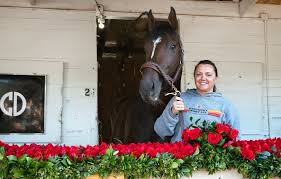
A native of Saratoga Springs, N.Y., DeVaux’s roots trace back to Monticello Raceway and a family lineage embedded in harness racing after her father, Adrian “Butch” DeVaux, bought a horse for a hundred dollars.
“I remember many a cold night at Monticello,” DeVaux recalled. “We were in Barn G, which is at the very top of the hill. My mother would throw a blanket over the horse after it got done racing, and it would still be harnessed up, and I would ride the horse up to the top of the hill back to the barn. My brothers would have the bike behind the station wagon, and I’d be on the horse.”
Though her time in harness racing ended when she was still young, the foundation never left. Her siblings remained in the sport, continuing the family’s presence at both Monticello and Saratoga raceways, while DeVaux carried those early lessons into a different corner of the industry.
Her path, however, was not linear.
In college, she stepped away from racing entirely, pursuing a future in physical therapy while studying pre-med. For a time, it seemed her life would move in a different direction – one far removed from barns and backstretches.
But, as many in the industry understand, racing always has a way of calling people back.
After college, she gravitated towards the Thoroughbred racing world after her mother proposed an opportunity to work as a hot walker at Saratoga. She became a stable worker for trainer Chuck Simon and the rest became history.
Simon inspired DeVaux to gear toward a more management position in racing. After working for Simon for six years, she transferred to trainer Chad Brown’s operation to work as his assistant, a title she held for eight years.
In 2018, she obtained her trainer’s license and sent out her first winner in March 2019. To date, DeVaux has recorded 299 wins with earnings upwards of $36.4 million.
Though she was young when her story in harness racing concluded, DeVaux said that she always carries the hard work she learned from the sport with her as a trademark for success in any racing career.
“It’s hard work, no matter what you do. You don’t leave until it’s ended,” she said.
When Derby Day arrived, most of their family was able to attend the Run for the Roses in Kentucky, labeling their travels as “DeVauxs on the Geaux”. Of those in attendance included her brother Kenny DeVaux, a well-known horseman at Monticello Raceway, and his wife, Dawn, as well as her sister Adrienne DeVaux, a Thoroughbred trainer herself.
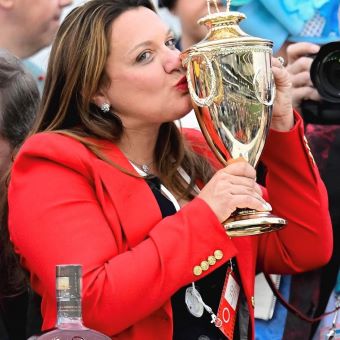
“It was a great moment, and I was very happy they could be there. It’s hard for me to say that we made history, but we did. And it would only be right that everyone got to share in that experience.”
Not all of them could be there, though. Jimmy DeVaux was unable to attend due to having 10 drives at Saratoga on that same day in addition to a full week of racing ahead at the Upstate New York half mile oval. Jim DeVaux is Cherie’s older brother. A multiple leading driver at both Monticello and Saratoga, he is closing in on 8,000 driving wins with over $43.45 million earned.
“What [the win] did for the family, it’s great. Just the journey of it really. All of it is great. I don’t even know if it’s processed yet,” Jim DeVaux said.
In a way, it was fitting. The races never stop; the responsibility never stops. Because even at the pinnacle of Thoroughbred racing, a day defined by history, the values of racing through hard work and dedication, remain the same and there are no days off.
In the $5 million race, Golden Tempo bided his time and made his move from last on a charge for the front. During the race, DeVaux recalled watching him run his race, then catching the horse on the front, and not believing that he finished ahead of that horse. Though there was no certainty in winning the Kentucky Derby, after winning the Lecomte Stakes in a last-to-first effort, Golden Tempo was pointed with all roads leading to the big day.
“It’s been a whirlwind couple of days,” DeVaux said. “We won the race, but we still have a very large operation. My business as a horse trainer is first and then, trying to be a representative of the Thoroughbred industry, it’s something that I feel like I am trying to do a good job at. We’re just trying to get our bearings and come up for air.”
DeVaux runs a full operation with a full barn of several horses in addition to her newly crowned champion and while the spotlight and interviews are a cherished place to be following a monumental achievement, a true horseman prefers to be in the barn alongside her horses.
Although she wrote her name in the history books as the first woman trainer to win a Kentucky Derby, DeVaux doesn’t let that define her.
“I’m just a horse trainer that happens to be female,” she said. “I never set out to make my gender my whole identity and purpose for doing this. It’s a bonus if I can be that person that others, other women, little girls, look up to. That’s a bonus and I’m very appreciative of that. And it’s quite the honor, but it’s never been part of my life or reason for being a trainer or accelerating and trying to compete at the highest level in the sport.”
Most of her time in racing has been those quiet, unseen moments beyond the cameras and interviews when it’s just her and her horses.
“As with all of my horses, we give them a lot of attention,” DeVaux said. “We’re trying to let (Golden Tempo) relax and get over all of this. He went back to the track. He’s back into his routine. So, we are happy to just let him get back into his normal routine.”
Many in harness racing can resonate with the little girl that helped her parents in the barn on late nights, no matter if it was a school night or not, bringing horses back to the barn and finishing up after racing; but not many can imagine going from those long nights to the biggest stage in racing history in front of millions. And while DeVaux doesn’t want to be known just for being the first female trainer to win the Kentucky Derby, she hopes to inspire the next generation with a message focused on driving forward and working hard.
“Just keep taking steps in a forward direction. You’re going to make mistakes. You’re going to have things happen. You’re going to make decisions you’re not proud of. And you just have to keep moving forward. Nothing defines you. Learn the lesson and move forward,” DeVaux concluded.